Co-Dependence Is an Addiction, Not a Personality Trait
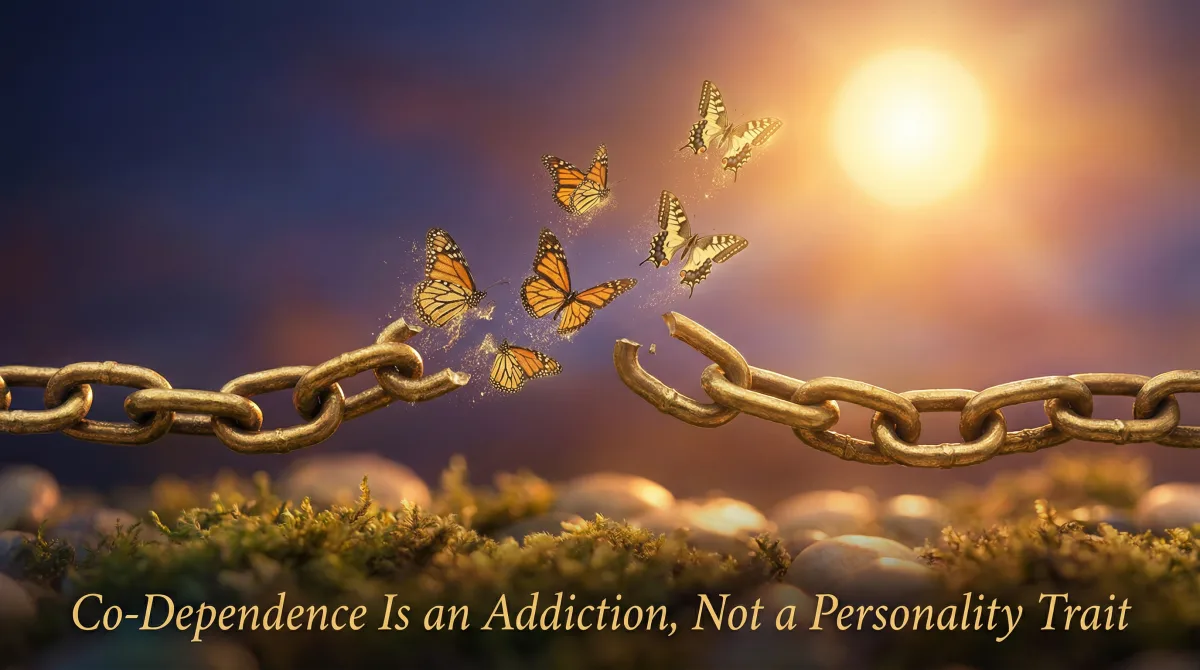
Co-dependence is framed as self-abandonment rather than identity. Explore enmeshment, forgiveness without renewed access, and a reflection on your own needs.
Co-Dependence Is an Addiction, Not a Personality Trait
Co-dependence, in this teaching, means abandoning your own feelings and needs to keep another person close. The distinction is not between loving and being cold. It is between caring while remaining yourself and making another person's approval the price of your safety. The way back begins with recognizing the merger, feeling what is yours, and reclaiming space for your own life.
You're not "too caring." You're not "too empathic." You're not "just a loving person who gives too much." You're addicted.
Co-dependence is not a personality quirk. It's a systematic abandonment of self in exchange for the illusion of connection, safety, or love. It's organizing your entire existence around another person's needs, moods, and dysfunction. And until you name it as addiction - not codependency, not attachment style, ADDICTION - you will keep treating it as a relationship problem when it's actually a nervous system problem and a brain chemistry hijack.
What Co-Dependence Looks Like Across Nine Dimensions
Your body is theirs - nervous system syncs with theirs. Your thoughts are about them - more mental energy on their problems than yours. Your feelings are merged - you can't identify what you feel separate from what they feel. Your energy field is not boundaried - it's merged. Your identity is "their person." You confuse enmeshment with divine connection.
Why Co-Dependence Makes Forgiveness Impossible
You cannot forgive someone you're still energetically merged with. Forgiveness requires separation. Co-dependence is merger. You can't see them clearly because your perception is distorted by need. You can't feel your anger because anger threatens the connection.
I remember sitting across from a woman whose entire body tensed every time she spoke about her partner. Her breath was shallow, chest rising and falling erratically like a trapped bird fluttering against glass. It wasn’t just emotional with her - her nervous system had been rewired for survival, synced so tightly to his moods that she couldn’t even feel where she ended and he began. Watching her somatic container collapse, I knew breaking out required more than talk. It was about rewiring the body, unlearning the addiction stored in muscle and nerve.
Years ago, when I was deep in a dark night of the soul, I caught myself dissolving in the mirror of someone else's pain. My mind spun wild loops trying to solve their chaos, drowning mine. It hit me like a gut punch: I was addicted to that frantic energy, mistaking it for caring. Amma’s hugs didn’t fix it, but the steady practices of breath and shaking did. I had to reclaim my nervous system inch by inch, down to the cellular level, before I could stand fully in myself again.
So you "forgive" prematurely - to maintain connection. They harm you again. Repeat infinitely. This isn't forgiveness. It's imprisonment with Stockholm syndrome.
The Way Out
Step one: Name it as addiction. Step two: Feel the terror of separation. Step three: Radical separation - complete no contact.
Only after you've broken the co-dependent bond can real forgiveness emerge. That forgiveness usually sounds like: "I forgive you, and I'm still never seeing you again."
That's not unforgiveness. That's freedom.
Om Dum Durgayei Namaha
Forensic Forgiveness maps co-dependence across all nine karmic categories and provides the eight-step radical path out.
Get Forensic Forgiveness → paulwagner.com/forensic-forgiveness
The Roots of the Addiction: Where It All Begins
This addiction to another person doesn't just appear out of nowhere. It's a seed planted in the fertile ground of childhood, watered by a thousand tiny moments of 'be good,' 'don't make a fuss,' and 'what will people think?' For many of us, our survival depended on our ability to attune to our caregivers' needs, to become a mirror for their desires, to manage their emotional states so that we might receive a crumb of love or, at the very least, avoid their wrath. This is where the nervous system learns that safety is not found within, but in the approval of another. The brain forges powerful neural pathways that equate 'merging' with 'surviving.' In my 35 years of practice, I've seen this pattern again and again. The client who can't leave an abusive partner is often replaying a childhood drama where love and danger were inextricably linked. They are not weak; they are in the grip of a powerful, deeply ingrained survival strategy that has outlived its usefulness. You might also find insight in Why Ritual Matters - The Ancient Technology That Modern H....
Melody Beattie's Codependent No More is the book that helped millions of people stop losing themselves in others.
Rose quartz is the stone of unconditional love ~ keep one close when you are doing heart work. Seriously. I know it sounds woo-woo, but this pink bastard has gotten me through some brutal self-examination sessions. When you're peeling back layers of codependent bullshit, you need something gentle to anchor you. Rose quartz doesn't judge your mess. It just sits there radiating this soft energy while you figure out where your love ends and your addiction to being needed begins. Know what I mean? The stone doesn't fix anything for you ~ it's not magic like that. But it holds space. And sometimes when you're in the thick of realizing how much of your identity got wrapped up in rescuing people, you need something that says "you're still worthy even when you're not useful." That's what this little chunk of pink does. Think about that.
Bessel van der Kolk's The Body Keeps the Score is essential reading for anyone on a healing journey. This book changed how I think about trauma completely. Van der Kolk doesn't just talk about what happened to you ~ he shows you how it's literally living in your nervous system right now. The way he explains how our bodies hold onto shit we thought we'd forgotten? Mind-blowing. If you're stuck in codependent patterns and can't figure out why you keep repeating the same damn cycles, this book will connect the dots between your childhood experiences and your current relationship disasters. Seriously.
A weighted blanket can feel like a hug from the universe, especially on nights when the mind will not stop.
The Alchemical Fire of Separation
Breaking the co-dependent bond is not a gentle process. It is a trial by fire, a radical act of choosing the terrifying uncertainty of selfhood over the familiar hell of enmeshment. where the real spiritual work begins. The 'no contact' rule is not a punishment; it's a necessary quarantine. It's about creating a sacred space where your own nervous system can finally come out of its chronic state of high alert. In this space, you will meet the raw, untamed energy of your own feelings ~ the grief, the rage, the terror. the energy you have been suppressing for a lifetime. Your job is not to fix it, but to feel it. And I mean that.To let it move through you. What we're looking at is the alchemical fire that purifies the soul. It is in this fire that you will forge a new identity, one that is not defined by another, but by your own connection to the Divine. Explore more in our healing hub guide.
Beyond Forgiveness: The Path to True Freedom
The premature forgiveness that is so common in co-dependent relationships is a spiritual bypass of the highest order. It's a way of avoiding the messy, uncomfortable work of true separation. Real forgiveness can only happen after the bond is broken, after you have reclaimed your own energetic sovereignty. And it often looks nothing like the Hallmark card version. It might be a quiet acknowledgment that the other person was also acting from their own pain. It might be a fierce, unwavering commitment to never again allow them to harm you. It might be the simple, intense act of wishing them well from a safe distance. True forgiveness is not about letting them off the hook; it's about taking yourself off the hook. It's about releasing the energetic cords that have bound you, not so you can be 'friends,' but so you can be free. Paul explores this deeply in Forensic Forgiveness.
The Childhood Roots of Self-Abandonment
This addiction doesn't come from nowhere. It's forged in the crucible of a childhood where your needs were not met, where your feelings were not validated, where you learned that your survival depended on being attuned to the needs of your caregivers. As a child, this was a brilliant survival strategy. You became a master at reading the room, at anticipating the moods of others, at shapeshifting yourself to be whatever was needed to maintain a fragile sense of connection and safety. In my work with clients, I see this pattern over and over. This is where it gets interesting.The child who had to become the parent to their own alcoholic mother. The child who had to suppress their own ebullient joy so as not to upset their depressed father. You learned to abandon yourself because you had to. But now, as an adult, that same survival strategy is killing you. It is keeping you trapped in a cycle of self-betrayal, attracting partners and friends who require you to continue abandoning yourself. You might also find insight in Peter Levine's Somatic Experiencing: Healing Trauma Throu....
The Long Road Back to Self
Recovering from codependency is not about learning to be more selfish. It is about learning to have a self in the first place. It is the long, slow, and often painful process of repatriation, of coming home to a body and a soul that you have long since abandoned. It begins with the simple, radical act of asking yourself, 'What do I feel right now? What do I need right now?' At first, the answer may be silence. You have been a stranger to yourself for so long that you don't even know how to speak the language of your own heart. But with practice, with patience, with a fierce and tender compassion for the child within who learned to survive by disappearing, you will begin to hear the whispers of your own soul. the path of recovery. It is not a quick fix. It is a lifelong pilgrimage. But it is the only journey that leads back to the truth of who you are. If this connects, consider an deep healing session.
A Reflection: Where Do You Disappear?
Choose a recent moment when you tried to fix another person's mood. On paper, name their problem, then separately name your own feeling and need. Notice whether you can answer the second part without explaining, excusing, or solving them. If the answer is silence, let it be silence rather than inventing the correct answer.
Then ask what you were afraid would happen if you stopped rescuing. The point is not to build a case against them or force forgiveness. It is to notice the bargain in which connection costs you your own voice. Choose one small act that tends the need you named without managing their mood.
If separation could put you at risk, seek trusted support and plan for safety rather than treating this reflection as an instruction to confront someone or leave abruptly.
Continue Without Abandoning Yourself
For a next step in giving your own needs a clear boundary, read New Boundaries From Clear Ground. If the pull to forgive is really a pull to silence your hurt, Premature Forgiveness Is Self-Violence is a quieter companion to the distinction made here between release and renewed access.
The Complete Guide to Emotional & Spiritual Healing brings together teachings on emotional patterns, trauma, forgiveness, and self-compassion. Use it to keep exploring the return to self described here, rather than making another person's transformation the center of your work.
Questions About This Article
How does this article distinguish caring from co-dependence?
The article describes co-dependence as self-abandonment: organizing life around another person’s needs, moods, and approval while losing contact with your own feelings and needs.
What childhood pattern does the article connect with co-dependence?
It describes learning to read caregivers’ moods and suppress your own needs to preserve connection and safety, then continuing that survival pattern in adult relationships.
What is a first reflection for reconnecting with my own needs?
Recall a moment when you tried to fix someone’s mood. Name their problem separately from your own feeling and need, and notice whether you can answer without solving or excusing them.
Does forgiveness mean giving someone access to me again?
Not in this teaching. Forgiveness can include wishing someone well from a safe distance while remaining committed to not allowing further harm; renewed contact is not the measure of release.