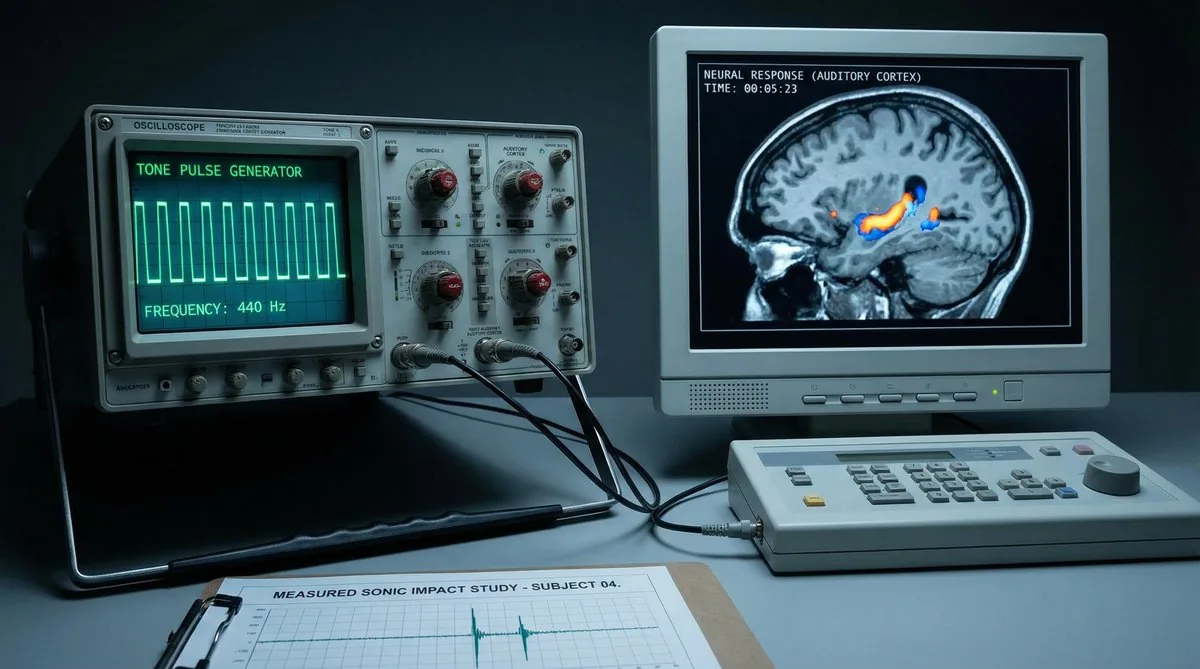
Isochronic tones are a single tone switched on and off at regular intervals, creating a steady pulse. People explore them as a listening aid for relaxation, focus, or meditation. The invitation here is to listen with attention, not to demand a breakthrough from your body.
The brain is experiencing quite the renaissance as of late. Not only has brain research become more easily accessible and immediately applicable, but the interest in sound and light has opened questions about how we experience calm, attention, and the body.
What’s even more compelling is that several categories of brain research are inspiring the creation of accessible and wearable technologies. The desire to soothe the brain, along with other parts of the body, is understandable. That desire deserves curiosity without turning every frequency into a promise of healing.
“If You Want To Find The Secrets Of The Universe, Think In Terms Of Energy, Frequency, And Vibration.” ... Nikola Tesla
It’s All About Light & Sound
Sound therapy has come a long way since its new-age hippie roots. Sound Therapy is now utilized by a variety of global organizations and businesses. This includes business offices, hotel chains, medical facilities, universities, and a variety of treatment programs, as an effective treatment to alleviate pain and depression, lower blood pressure, overcome feelings of stress, improve learning, improve balance, and promote physical and mental endurance. According to the Mayo Clinic, light therapy treats seasonal depression and other conditions by exposing a person to artificial light. During light therapy, the individual sits or works near a device called a light therapy box, which comes in a variety of forms, shapes, and sizes.
If you’re into frequencies and healing through sound and vibration, you’ll want to research everything you can about Sound Wave Therapy. People explore it while settling toward sleep or seeking focus. Within Sound Wave Therapy is audio-based brainwave entrainment (or just brain entrainment), which has become one of the hottest topics in life-changing technology.
I keep a singing bowl on my altar, the vibration alone is a form of prayer.
Brain entrainment is a simple idea with impressive implications: communicate with the brain using audio and light, and the mind and body will respond. After all, each of us is comprised of light and sound. Many believe that, over time, this therapeutic category will also be responsible for healing a long list of physical problems, although scientific research is at an early stage.
“If you look at the anatomy, the structure, the function, there’s nothing in the universe that’s more beautiful, that’s more complex, than the human brain.” ... Keith Black (Discover magazine, April, 2004)
What Are Isochronic Tones?
If you’ve heard of binaural beats, you may have learned about its younger cousin, isochronic tones. These tones are defined by a single tone being turned on and turned off in rapid successions, like pulses. Imagine putting on a headset and listening to regular beats of a single tone. This is known as isochronic. For a closer look at the other listening approach, continue with Healing Yourself With Binaural Beats: Facts & Fiction.
I’ve seen the brain shift in real time, not just in theory. Years ago, during a tough stretch of my own dark night, I used sound frequencies alongside breath work to crack open the tight knots in my chest. The trembling that followed wasn’t just emotional-it was the nervous system rewiring itself. I remember thinking: this is less about some mystical breakthrough and more about the body remembering how to function without all the old crap blocking it.
I’ve brought those same tools into my workshops in Denver, guiding people to shake out trauma and let their nervous systems find calm. One client, after just minutes with a simple isochronic tone pattern layered with breath cues, felt a deep shift in how her brain and body were connecting. It wasn’t some airy vision-it was a physical release she could feel waking up in her muscles and bones. This kind of work isn’t fluff. It’s the body doing what it was always designed to do.
While it might sound monotonous, listening to this simple set of sounds may offer a way to settle your attention toward a meditative state. Let your own response matter more than a promised result. Isochronic tones are part of a compelling trio that also includes binaural and monaural beats.
What Are Binaural Beats?
Binaural beats is an auditory experience through which the receiver listens dichotically (a unique frequency in each ear), where each frequency is lower than 1500 Hz, and the difference between the frequencies is lower than 40 Hz. The tones inherent in binaural beats can vary.
What Are Monaural Beats?
The sounds of monaural beats and binaural beats are similar, except that monaural beats are more specific. They consist of two separate, steady tones produced and mixed externally.
Isochronic Tones Vs Binaural Beats
Isochronic tones and binaural beats are related listening approaches, but they are not the same thing. Binaural beats use a different tone in each ear; isochronic tones are specifically a single, repeated tone, constructed and emitted in the form of pulses. Monaural beats, described above, mix two steady tones externally.
Do Isochronic Tones Work?
Do you feel more settled when you listen, or does the pulsing sound irritate you? That is a useful place to begin. People explore isochronic tones and binaural/monaural beats for relaxation and while winding down toward sleep. In some circles, they are affectionately known as sleep tones and sleep beats. That name is not a guarantee that you will sleep. Treat these as listening practices, not a cure or a replacement for medical care.
A Gentle Listening Practice
The singing bowl and breath work in this article point toward a simple experiment: give the body a little room, then notice what actually happens.
- Sit somewhere you can pause safely, not while driving. Choose a simple pulsed tone and keep the volume low and comfortable.
- Listen for two minutes while breathing naturally. No forceful breathing, no demand for a release. Notice your chest, jaw, and shoulders.
- Turn the sound off and sit quietly for a minute. Ask: did I feel more settled, unchanged, or more tense?
- If the sound feels irritating, painful, dizzying, or overwhelming, stop. Silence is a valid choice; there is nothing to push through.
If sound gives your attention an anchor, Mantra Meditation vs Silent Meditation explores how repeated sacred sound and quiet observation differ. For the wider work of listening to the body and releasing old wounds, continue through the emotional and spiritual healing guide.
What Is Life-altering Technology?
The definition of “life-altering technology” has evolved. While it was once a fairly nebulous term related to different facets of everyday life, it’s now more pinpointed toward the idea that as we create and evolve new technologies, we must consider the lives, hearts, and minds of every species on planet Earth. Earth-shaking technology now lives at the intersection of robotics, artificial intelligence, and the evolution of consciousness.
A leader at the intersection of tech and consciousness, and the co-founder of The Earth-shaking Technologies Conference, Rui Ma has a mission. She recently shared, “…competence, autonomy and psychological relatedness are basic psychological needs that are necessary for well-being. Another concept
I’m fascinated by is beneficence - or the sense of being able to give to others. We have theories on what makes people flourish, not just what their systems “want,” but what we know are core psychological needs for people to lead a “good life”. What if we built companies around that?”
Light and Sound Technologies
There is a new wave of tech being birthed, known as life-altering technologies. This category has come a long way. When it started in the late 1990s, the yield was poorly developed contraptions that made outlandish promises including brain growth, healing cancer, and doubling the IQ. It was a lot of snake oil backed by fascinating, abject hyperbole. Life-altering technology’s early origin gave it a poor reputation and nearly broke it.
More recently, science has stepped in and started punching holes in the ideologies behind this category of theories and products, not to dismantle it, but to improve upon it. What they’re finding is that the premises behind radical tech are not so penetrable. The interest in sound and its effects on the mind and body remains compelling, without making every product or promised outcome trustworthy.
What’s On The Horizon?
We know that the brain is not only fragile but also responsive and sensitive to external input. Its function is not solely information storage and retrieval. That sensitivity is part of what makes sound and light such intriguing areas to explore.
We are at a key point in the history and potential trajectories of technology. Until recently, consciousness and technology have evolved on two separate, independent tracks. If we can align them, if we can encourage deep and advanced dialogues between them, we will see immeasurable advancements in the human condition.
A weighted blanket can feel like a hug from the universe, especially on nights when the mind will not stop.
When this occurs on a global scale, technology will be of service to humanity, rather than the other way around.