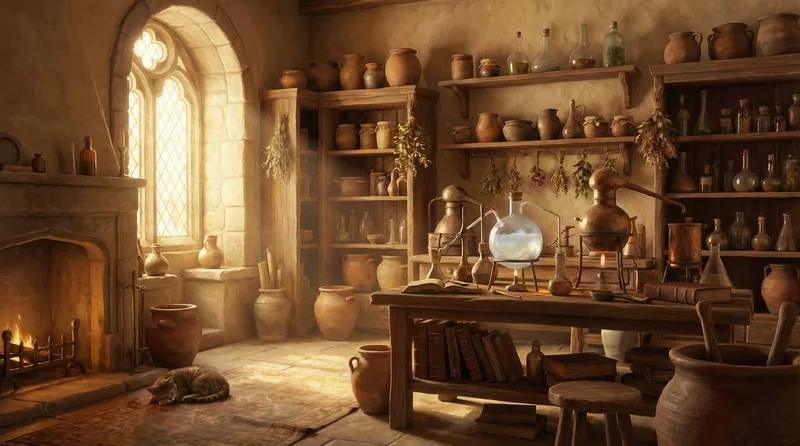
“When You Want Something, All The Universe Conspires In Helping You To Achieve It.”
― Paulo Coelho, The Alchemist
Famous Alchemists
Greco-Roman Egypt
Maria the Jewess (1st century)
Also known as “Maria the Prophetess”, she was a 1st-century inventor of several chemical and distillation apparatuses, which served as tools for alchemical experimentation and the creation of healing elixirs. Maria believed science should include a sprinkle of magic when she wrote the axiom, "One becomes two, two becomes three, and out of the third comes the one as the fourth."A good sage bundle is one of the simplest and most powerful tools for energetic hygiene.
A fan of Maria’s, the famous psychologist Carl Jung, referenced her insights when crafting his methodologies that explore the subconscious in pursuit of individuation.Zosimos of Panopolis (end of 3rd century/beginning of 4th century)
A Greek-Egyptian and Gnostic mystic, Zosimos’s most prized claim to fame was a treatise that he named, “Cheirokmeta” (in Greek, “things made by hand”). He defined alchemy as “the composition of waters, movement, and growth, embodying and disembodying, drawing the spirits from bodies, and bonding the spirits within bodies”.Zosimos was a student of Hermetic spirituality and believed that gender exists on each of the physical, mental and spiritual planes of existence. He was also an early believer in the idea that metallic transmutation was metaphoric of a human being’s inner process of purification and redemption. India
Agastya (around 1500 BCE)
Born with the name Kumbhayoni, Agastya spent part of his life as a hermit focused on spiritual asceticism. While he was known to be a striking and brilliant Vedic sage of Hinduism, he was also a husband and father. Agastya was an authority on the Rig Veda, the sciences, and weaponry. He is described in many early Hindu texts as having been somewhat of a God. Some even believe that Agastya had a miraculous birth with no known mother or father. Agastya was the author of spiritual poems and hymns, a teacher and perfecter of the Sanskrit and Tamil languages, and the author of “Agistimata”, a treatise on gems. He was also an artisan and lapidary (engraver, cutter, and polisher of stones). Many believe Agastya to have moved mountains and is now considered an ascended spiritual master, connected to all three branches of the Hindu tradition: Shaivism, Shaktism, and Vaishnavism.Kanada (Unclear, 6th ~ 2nd century BCE)
A renowned sage and philosopher, Kanada was an early developer of physics and a variety of other related scientific theories. He discovered and developed the notion of the atom, along with several atomic theories. He was the creator of Rasavādam (a type of alchemy focused on converting Mercury (Rasam) into other metals, most especially gold). Kanada believed that all living beings are composed of water, fire, earth, air, and æther. Kanada believed that time, space, and mind are inseparable and united as one.China
Wei Boyang (AD 151 - 221)
Practicing in private, Wei Boyang aspired to attain the eternal state of nothingness. He was known as a Taoist Internal Alchemist, who professed teachings that could prolong life and help initiates’ spirits become immortal. He was a champion and teacher of the Neidan, or internal alchemy, and he authored “Cantong qi”, which translates to “The Kinship of the Three, in Accordance with the Book of Changes.” This raw series is the earliest writing on alchemy in China, a series of esoteric doctrines that outline a variety of physical, mental, emotional, and spiritual practices. Wei Boyang believed in the Three Treasures: Jing (Essence), Qi (Internal Energy or Breath) and Shen (Spirit). He was also the first person to detail the chemical composition of gunpowder.“Worry Is Preposterous; We Don’t Know Enough To Worry.” - Wei Boyang
Ge Hong (AD 283 ... 343)
A scholar and philosopher, Ge Hong created First Aid in Traditional Chinese Medicine. His lifelong work was aimed at establishing a dialogue to help reconcile Daoism and Confucianism. Later in life, he became obsessed with immortality elixirs, believed that any person could obtain immortality through diligence and commitment. He also believed the ultimate goal was to achieve oneness with oneself.Islam And Persia
Jabir ibn Hayyan (AD 721 - 815)
In the western world, Jabir ibn Hayyan was known as “Geber”. He was an early founder of chemistry, and a polymath who merged several complex disciplines and bodies of knowledge with the focus of solving specific problems. As a renaissance humanist, Geber was proficient in astronomy, astrology, engineering, geography, philosophy, physics and pharmacology.Al-Kindi (AD 800 ... 870)
Al-Kindi is known as The Father of Arab Philosophy. He was a peripatetic (“nomadic”) philosopher, mathematician, physician, and musician. Al-Kindi synthesized and adapted Greek and Egyptian ideologies in the Muslim world, and wrote hundreds of original works about metaphysics, logic, ethics, psychology, cosmology, medicine, mathematics, zoology, astronomy, jewels, dyes, tides, mirrors, and meteorology. Al-Kindi had one of the broadest spectrums of proficiencies in the history of alchemy, if not the history of the world.Al-Tughrai (AD 1061 ~ 1121)
Al-Tughrai was Persian, a prolific writer of poems, an astrologer, and most more to the point, the writer of the compendium of Arabic alchemical writings known as “Mafatih al-rahmah wa-masabih al-hikmah”. Al-Tughrai also translated Zosimos of Panopolis’s writings on alchemy from Greek to Arabic. No small feat.Europe
Rudolf Steiner (2/25/1861 - 3/30/1925)
Rudolf Steiner is of the most intense and unique thinkers and alchemists in modern history. Steiner was a designer, artist, agriculturist, architect, and student of medicine. He was most known for initiating and developing The Waldorf school movement. Steiner influenced Piet Mondrian, Wassily Kandinsky, Joseph Beuys, Olafur Eliasson, and Tony Cragg.“Just as the body, eye, and ear develop as organs of perception, as senses for bodily processes, so does a man develop in himself soul and spiritual organs of perception through which the soul and spiritual worlds are opened to him.” ― Rudolf Steiner, Theosophy
Roger Bacon (1219 or 1220 - 1292)
Know as Doctor Mirabilis (“Doctor Marvelous”), Bacon was a philosopher, Franciscan Friar, wizard, magician, student of Aristotle, and advocate of his scientific method. He was also a student of Arab scientist Alhazen (Arab astronomer, mathematician, and physicist). I remember sitting with a client in Denver who was trapped in a cycle of rage and grief after losing her mother. We worked through breath and subtle shaking techniques, unlocking tension she'd held in her chest and shoulders for years. That physical release cracked open space for her to say things she hadn't dared speak before. The nervous system doesn't lie; it's the body's way of making sense when the mind can't. Years ago, during a particularly dark night of the soul, I found myself trembling uncontrollably in a small ashram room after Amma's darshan. The shaking was fierce, raw - no room for control or ego. In that shaking, the old stories about who I thought I was dissolved like smoke. That moment didn't come from books or teachings; it came through the body’s urgent need to realign with something far beyond intellect.Eckhart Tolle's The Power of Now remains one of the most important spiritual books of our time.
Throughout his life, Bacon studied nature through the lens of empirical data and was fascinated with necromancy, through which he would summon spirits and communicate with the dead. He wrote, “Opus Majus,” “Opus Minus,” and “Opus Tertium” in medieval Latin, a raw compendium on grammar, mathematics, physics, and philosophy. He is also known for revising the medieval university curriculum. Legend also has it that Roger Bacon developed a “Brazen Head”, akin to the Great and Powerful Oz. This mechanical wizard’s tool was made of brass or bronze and was allegedly able to answer any question.Paracelsus (1493 or 1494 ... 9/24/1541)
Paracelsus was born Theophrastus von Hohenheim. During his life, he was a military surgeon, writer on medical philosophy (titles include, “Paragranum” and “Opus Paramirum”), a physician, alchemist, chemical analyst, astrologer, renaissance man, pioneer, and the founder of a medical revolution that focused on observation in conjunction with accrued wisdom.There is something about a sandalwood mala that carries the energy of thousands of years of devotion. You can feel it the moment the beads touch your fingers ~ this isn't just wood carved into spheres. This is centuries of monks and mystics running these same smooth surfaces between their thumbs, counting breaths, whispering mantras into the grain itself. I've held malas that were so worn the bead holes had gone oval from decades of thread moving through them. Think about that. The scent alone tells stories. Sweet. Earthy. Ancient. Like walking into a temple where ten thousand prayers still hang in the air, waiting for you to add yours to the mix. And here's the thing that gets me ~ sandalwood doesn't just hold scent, it holds intention. Every time someone used that mala to center themselves, to find their breath again, to remember what matters... some part of that stays. You're not buying beads. You're inheriting a practice.
Paracelsus was known as the “Father of Toxicology” and was loved by the Rosicrucians as a diviner-prophet and occultist. Paracelsus subscribed to Hermeticism, believing that health and sickness are born from balances and imbalances between human beings and nature.John Dee (7/13/1527 - 1608 or 1609)
John Dee was an advisor to Queen Elizabeth I, and a Hermetic Philosopher, mathematician, astronomer, astrologer, occultist, and student of divination. He promoted the idea that magic and science are intertwined, and he sought to understand transcendence and the invisible world of angels and spirits. As a student and lover of Copernicus and Pythagoras, Dee believed that numbers were the basis for our physical realities. He was also a leading authority on navigation and a consultant to England’s early voyagers.August Nordenskiold (2/6/1754 - 12/10/1792)
Nordenskiold was commissioned by King Gustav III of Sweden to find “The Philosopher’s Stone,” so that he could use it to turn all of Sweden’s metals into gold. His goal was to obliterate the value of gold so that financial tyranny and the power that gold created would no longer exist. A humanist, Nordenskiold was a defender of the anti-slavery movement, and a disciple of the day’s new brand of Christianity, known as Swedenborgianism.“That there are two Worlds, the Spiritual or Substantial, and the Natural or Material.” - August Nordenskiold
United States
Diana Di Prima (8/6/1934, age 84 years at the time of this article)
A unique and powerful soul, Di Prima is alive as of this writing and one of the world’s most famous female alchemists. Diana is a life-long feminist, beat poet, anti-authority Brooklynite, and a student of Zen and Tibetan Buddhism. She is a lover of Sanskrit, healer, and worker of magick. Di Prima is keeping alchemy alive through her striking writing and thoughtful activism. Joseph Matheny writes of his interview with Di Prima: “Conjuring, straddling the magick/dream line, throwing us bits of tasty meta-morsels and sumptuous subconscious feasts from the other side.”“Remember That Wherever Your Heart Is, There You Will Find Your Treasure.” ― Paulo Coelho, The Alchemist
Famous Alchemist Quotes
- “One Man’s ‘Magic’ Is Another Man’s Engineering.” - Robert A. Heinlein
- “There Is An Alchemy In Sorrow. It Can Be Transmuted Into Wisdom, Which, If It Does Not Bring Joy, Can Yet Bring Happiness.” - Pearl S. Buck
- “Magic Is Not A Practice. It Is A Living, Breathing Web Of Energy That, With Our Permission, Can Encase Our Every Action.” - Dorothy Morrison
- “The Real Alchemy Is Transforming The Base Self Into Gold Or Into Spiritual Awareness. That’s Really What New Alchemy’s All About.” - Fred Alan Wolf
- “True Magic Is The Art And Science Of Changing States Of Mind At Will.” - Douglas Monroe
- “Alchemy Is The Art Of Manipulating Life, And Consciousness In Matter, To Help It Evolve, Or To Solve Problems Of Inner Disharmonies.” - Jean Dubuis
Palo santo has been used for centuries to clear negative energy and invite in the sacred. The shamans knew what they were doing when they called it "holy wood." You light that stick and the smoke doesn't just smell good ~ it shifts something in the room. Something real. I've watched skeptics go quiet when that sweet, woody scent fills a space. Their arms uncross. Their breathing changes. It's not just hippie nonsense. There's something ancient working here, something that cuts through the bullshit of modern life and reminds you that some things are bigger than your daily grind. I've burned it in corporate boardrooms and meditation halls, trailer parks and million-dollar homes. Same result every time. The energy changes. People soften. Know what I mean? It's like the wood remembers what sacred actually feels like, and when you light it, that memory fills the air and whispers to something deep in your bones.
Alchemy has had a deep effect on the world and will continue to do so. Sadly, while alchemy had incredible momentum from 3000 BC through to the mid-1800s, it began to nose-dive upon science’s fascination with a newly fangled category known as the “drug industry.” It appears that rather than continue to explore the depths of the human condition, 19th-century alchemists chose a circuitous detour (and financial windfall), returning to the surface with a focus on symptoms. Thanks to today’s enlightened writers and alchemists, alchemy is making a stunning come-back.