Attachment vs. Love: How to Tell the Difference in Relationships
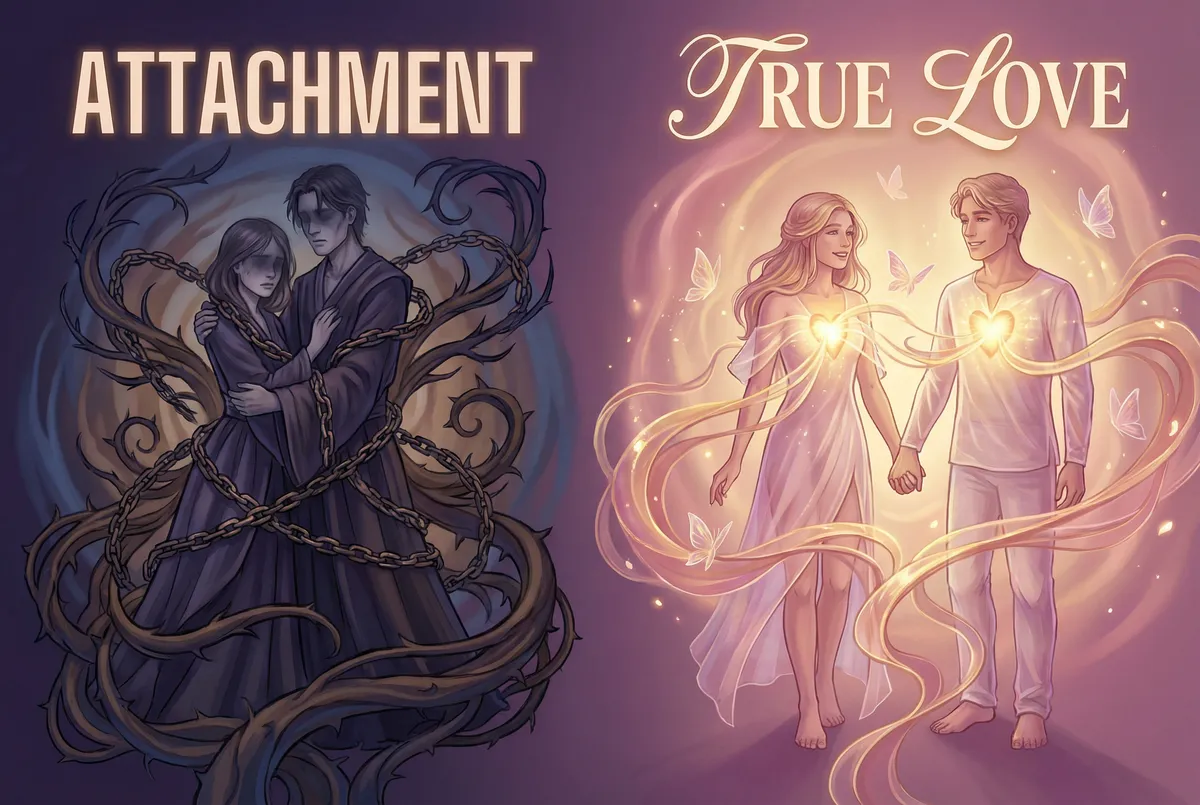
Secure attachment supports love. Learn to recognize fear-driven clinging, respect both partners' freedom, and choose care without abandoning your own needs.
The difference between attachment and love is not whether you need connection. Secure attachment gives a relationship trust and safety; love brings care for the other person's well-being and room for both of you to grow. The trouble begins when fear turns connection into clinging, possession, or control.
Ask yourself: am I trying to make this person responsible for my worth, or can I care about them while respecting both their freedom and my own needs? Love and attachment can coexist. The aim is not to stop needing people, but to notice when fear is running the relationship. An open heart does not require tolerating harm or abandoning your boundaries.
What Is Attachment? A Deeper Dive
Attachment, in a psychological sense, is the deep emotional bond that connects one person to another. It’s a fundamental human need, rooted in our earliest experiences with our caregivers. As infants, we form attachments to our parents or primary caregivers for survival. This initial bond shapes our “attachment style” and creates a blueprint for how we relate to others throughout our lives. It’s the invisible force that pulls us toward connection, seeking safety, comfort, and a sense of belonging.
“Attachment refers to how you relate to others. Your earliest bonds highly influence your relational style, including what you expect from people, how you interpret relationships, and how you behave in relationships.” - Psych Central
Think of your attachment style as your internal working model for relationships. It's a set of unconscious beliefs and expectations about how relationships work, based on your first experiences of being cared for. This model then guides your behavior in adult relationships, often without you even realizing it. The crazy part? Most of us are running on autopilot with relationship software we downloaded when we were three years old. Your nervous system learned what "safe" feels like before you could tie your shoes, and it's still using that same blueprint to evaluate every romantic partner you meet. When someone acts in a way that matches your early template of care... even if that care was anxious or inconsistent... your body reads it as "love" because it feels familiar. Think about that. We often mistake familiarity for compatibility, comfort for connection.
There are four primary attachment styles:
- Secure Attachment: If you have a secure attachment style, you likely had caregivers who were consistently responsive to your needs as a child. As an adult, you feel confident in your relationships, trust your partner, and are comfortable with both intimacy and independence. You see relationships as a safe harbor, a source of comfort and support, but you also have a strong sense of self and don’t rely on your partner for your sense of worth. You can communicate your needs openly and honestly, and you’re able to handle conflict constructively.
- Anxious-Preoccupied Attachment: If you have an anxious-preoccupied attachment style, your caregivers may have been inconsistent in their responsiveness. As a result, you crave closeness and intimacy but often feel insecure in your relationships. You might worry that your partner doesn’t love you as much as you love them, and you may be prone to jealousy and clinginess. You might find yourself constantly seeking reassurance from your partner, and you may have a hard time being alone.
- Dismissive-Avoidant Attachment: If you have a dismissive-avoidant attachment style, your caregivers may have been emotionally distant or dismissive of your needs. As an adult, you value your independence and self-sufficiency, often avoiding deep emotional connections to protect yourself from getting hurt. You might see relationships as messy and entangling, and you may prefer to keep your partners at arm’s length. You might have a hard time expressing your feelings, and you may shut down or withdraw when things get too emotional.
- Fearful-Avoidant (Disorganized) Attachment: If you have a fearful-avoidant attachment style, you may have experienced trauma or abuse in your childhood. As a result, you desire close relationships but also fear them. This creates a confusing mix of wanting and pushing away intimacy. You might find yourself in tumultuous, on-again, off-again relationships, and you may struggle with a deep sense of unworthiness.
While attachment is a natural and healthy part of relationships, it can become unhealthy when it's driven by fear, insecurity, or a need for control. This is often what we mean when we talk about "attachment" in a negative sense-a clingy, dependent, or possessive way of relating to a partner. It's when the need for security becomes so all-consuming that it stifles growth, freedom, and genuine connection. Think about it. You've probably seen this in action - maybe even in your own relationships. The constant checking of phones. The need to know where your partner is every second. The subtle (or not so subtle) attempts to control their choices, their friends, their time. This isn't love protecting itself; it's fear wearing love's mask. And here's the kicker: the tighter you grip, the more likely you are to squeeze the life out of what you're trying to hold onto. Know what I mean?
What Is Love? More Than a Feeling
Love, on the other hand, is a more expansive and complex emotion. It's a deep feeling of affection, care, and compassion for another person. While attachment is often about what you can get from a relationship (security, validation, a sense of self), love is about what you can give. I am not kidding. It's a selfless and unconditional expression of care for another person's well-being. Real love doesn't keep score. It doesn't demand reciprocity or performance metrics. When you love someone, you actually want them to be happy even if that happiness doesn't directly benefit you ~ even if it means they might outgrow you or choose a different path. That's fucking terrifying for most people, which is why we default to attachment so often. Love asks you to care about their dreams, their growth, their authentic self... not just the version of them that makes you feel good about yourself. Think about that.
The American Psychological Association defines love as a complex emotion involving "deep fondness, happiness in the beloved's presence, commitment to the other's well-being, and awareness of how words and actions affect the love object." But here's the thing - that clinical definition barely scratches the surface of what real love actually feels like when you're living it. True love has this quality of spaciousness to it, this sense that you can breathe around the other person. You're not constantly monitoring their mood or walking on eggshells. You genuinely want good things for them, even if those good things don't directly benefit you. That's the awareness part - you start seeing how your shit affects them, and you actually care enough to do something about it.
Love is not about possession or control. It's about honoring and respecting your partner as a whole person, separate from yourself. It's about wanting what's best for them, even if it doesn't directly benefit you. Think about that for a second ~ when was the last time you genuinely wanted something for your partner that had nothing to do with making your own life easier or better? That's the real test right there. Love is a choice you make every day to show up for your partner with an open heart and a generous spirit. Not when you feel like it. Not when they've earned it. Every damn day, even when they're driving you nuts or you're stressed about work or life feels like it's falling apart. It's an action, a practice, a way of being in the world. And here's the thing ~ it gets easier with practice, but it never becomes automatic. You have to keep choosing it.
In my work as an intuitive reader, I've seen love in all its forms. I've seen the fierce, protective love of a parent for their child, the deep, abiding love of a long-married couple, and the earth-shaking, healing love that can emerge between two people who are committed to their own growth and to the growth of their relationship. But here's what gets me - real love doesn't demand. It doesn't clutch. When I sit with clients who are drowning in what they call "love," I can feel the difference in my bones. True love has this quality of spaciousness, like breathing room for the soul. It says "I want you to be free" even when that freedom scares the shit out of us. Love is the energy that connects us all, the force that heals all wounds, and the light that guides us home. And sometimes, love means letting go completely.
Years ago, I sat with a woman whose body was locked tight from years of clinging to a relationship that wasn’t love but desperate attachment. Her breath was shallow, her nervous system screaming for release. We worked through somatic exercises-shaking, deep breath cycles-and slowly, I watched the layers of survival dissolve. Attachment had been a cage, but when her body found freedom, her heart began to recognize what love actually felt like.
I remember my own dark nights of the soul when my ego was unraveling piece by piece. Sitting in Amma’s darshan, I felt the pull of attachment-grip on identity, on old wounds, on wanting things to be a certain way. But the hug from her, firm and real, cracked open something raw and undeniable inside me. It wasn’t sentimental or sweet; it was a gut-level unbinding from the false self I’d been clutching for decades. That’s where love started distinguishing itself from mere attachment for me.
Attachment vs. Love: The Key Differences
So, how can you tell the difference between attachment and love in your own relationships? Here are some key distinctions that'll cut right through the bullshit we tell ourselves about romance: When you're attached, you're basically clinging to someone because you need them to feel complete. That's not love ~ that's dependency wearing a pretty mask. Real love? It lets the other person be exactly who they are, flaws and all, without trying to change them or control the outcome. Attachment says "I can't live without you." Love says "I want to share this life with you." Big fucking difference, right?
| Attachment | Love | |
|---|---|---|
| Focus | Self-focused: “How does this person make me feel? What can I get from them?” | Other-focused: “How can I support and care for this person? What can I give to them?” |
| Motivation | Fear, insecurity, need for validation, a desire to fill a void within yourself. | Genuine care, compassion, a desire for connection, and a celebration of the other person’s being. |
| Behavior | Controlling, possessive, jealous, demanding, score-keeping, and a need for constant reassurance. | Trusting, supportive, respectful, generous, forgiving, and a celebration of each other’s freedom. |
| Emotional Experience | Anxiety, obsession, emotional highs and lows, a sense of desperation, and a fear of being alone. | Calm, peace, stability, deep joy, a sense of contentment, and a feeling of being at home. |
| Sense of Self | Your sense of self is dependent on the relationship. You feel lost without your partner. | You have a strong sense of self outside of the relationship. You are a whole person on your own. |
| Growth | Attachment often stifles growth, as the focus is on maintaining the status quo and avoiding change. | Love encourages growth, as both partners are committed to supporting each other’s evolution. |
Personal Experience Signals: Tuning In to Your Inner Wisdom
One of the most powerful ways to distinguish between attachment and love is to pay attention to your own inner experience. Trust me on this one. Your body, your emotions, and your intuition are constantly giving you feedback about the quality of your connection. It's like having an internal GPS that most of us have learned to ignore. Think about it ~ when you're truly loving someone, your chest opens. You breathe easier. There's this spaciousness inside you, even when things get messy. But attachment? That shit feels tight. Constricted. Like you're holding your breath and waiting for the other shoe to drop. Your nervous system knows the difference before your mind catches up, seriously. I've watched this play out in my own relationships and with clients for years now. The body doesn't lie about this stuff. Here are some personal experience signals to tune in to:
These sensations are invitations to pay attention, not a test that proves whether you love someone. A tight chest alone cannot tell the whole story. Look at repeated behavior too: can you speak honestly, say no, and disagree without being controlled? Caring for your partner does not mean ignoring your own needs.
- How does your body feel when you’re with your partner? Do you feel relaxed, open, and at ease? Or do you feel tense, constricted, and on edge? Your body is a powerful barometer for the emotional climate of your relationship.
- What is the emotional tone of your relationship? Is it characterized by joy, laughter, and a sense of playfulness? Or is it heavy, serious, and fraught with drama?
- Do you feel free to be yourself in the relationship? Can you express your true thoughts and feelings without fear of judgment or rejection? Or do you feel like you have to walk on eggshells or hide parts of yourself to keep the peace?
- Do you feel energized or drained by the relationship? Does spending time with your partner leave you feeling uplifted and inspired? Or does it leave you feeling depleted and exhausted?
Take some time to sit with these questions. Journal about them. Meditate on them. Your inner wisdom knows the truth ~ it really does, even when your mind is screaming otherwise. The more you learn to listen to it, the more you'll be able to work through your relationships with clarity and grace. But here's the thing: that inner voice gets quieter when we're desperate or scared. So create some space. Get quiet. Maybe it's ten minutes in the morning before you check your phone, maybe it's a long walk without podcasts. I don't care how you do it, just do it. Because that voice ~ your actual intuition, not your fear talking ~ will tell you whether you're clinging or loving. Think about that. It already knows the difference between the two, even if your ego doesn't want to hear it.
A Five-Minute Reflection: From Fear to One Honest Choice
Choose one recent, low-stakes moment when you wanted reassurance or felt afraid of losing the connection. Use the article's pause, body awareness, and journaling questions to look at that moment, not to judge your entire relationship.
- Pause and notice. Put the phone down for a moment. Notice your chest, belly, and jaw without forcing yourself to relax. Name what you feel: fear, loneliness, anger, or something else.
- Separate the event from the fear. Write two lines: "What happened was ___." "The story I am telling myself is ___." A delayed reply, for example, is not the same thing as knowing you are being abandoned.
- Ask what care would do. Finish: "What I need is ___." Then ask, "Can I express that need without checking, demanding, or controlling? What freedom do we both need here?"
- Choose one honest action. Make a clear request, keep a boundary, or give yourself some time before responding. A request might be, "Could we talk tonight about how we stay in touch?" The other person still gets to answer honestly.
Afterward, note whether your choice respected both people, not whether it made all the anxiety disappear. This is practice, not a diagnosis or a demand to stay in a painful relationship. If speaking up could put you at risk, prioritize safety and seek support rather than using this exercise to confront someone.
Which Is Right for You? Cultivating Secure Attachment and Deep Love
Ultimately, both attachment and love are essential for healthy, long-term relationships. A secure attachment provides the foundation of trust and safety that allows love to flourish. Without a healthy attachment, relationships can become a source of anxiety and insecurity. But without love, attachment can feel empty and transactional. Think about it this way: attachment is like the root system of a tree, and love is the fruit it bears. You can't have healthy fruit without strong roots, but roots alone don't make a tree worth having. I've seen couples who are securely attached but emotionally distant ~ they function well together but there's no spark, no genuine care. Stay with me here. On the flip side, I've watched relationships burn out because the love was intense but the attachment was chaotic. They'd swing between passion and panic, never finding that steady ground where both people feel truly safe to be themselves. The sweet spot? When your nervous system feels calm with someone AND your heart genuinely wants their happiness.
The key is to cultivate a secure attachment style and to choose a partner with whom you can share a deep and abiding love. This means working on your own emotional security, learning to communicate your needs and boundaries in a healthy way, and choosing a partner who is also committed to their own personal growth. But here's the thing ~ this isn't some weekend workshop bullshit. This is daily practice. Real work. You're literally rewiring decades of conditioning about what love looks like, what safety feels like, what you deserve. Most people think they can skip the self-work part and just find "the right person." Wrong. You bring your baggage to every relationship, period. The question is whether you're willing to unpack it or just keep cramming more shit in there. For more on caring without possession or emotional withdrawal, continue with The Real Meaning of Non-Attachment.
If you find yourself struggling with unhealthy attachment patterns, don't despair. It's possible to heal and develop a more secure attachment style. I've seen this shift happen countless times, and honestly? It's some of the most rewarding work you can do. The thing is, these patterns didn't form overnight, so don't expect them to vanish in a week. Be patient with yourself. Seriously. Here are some practical steps you can take: Start by noticing when you're operating from fear versus love. When you feel that familiar panic of "they're going to leave me" or "I need to control this," pause. Just pause. That awareness alone is huge. When fear makes it hard to name your needs, read The Power of Boundaries: Protecting Your Energy for ways to care without abandoning yourself.
- Get to know your attachment style. The first step is to understand your own attachment patterns. There are many great books and online resources that can help you identify your attachment style and understand how it’s impacting your relationships.
- Heal your inner child. Our attachment styles are rooted in our childhood experiences. Healing the wounds of your inner child can help you break free from old patterns and create a more secure internal foundation.
- Practice self-compassion. Beating yourself up for your attachment patterns will only keep you stuck. Instead, practice treating yourself with the same kindness and understanding that you would offer to a good friend.
- Learn to communicate effectively. Healthy communication is the lifeblood of any good relationship. Learning to express your needs and boundaries in a clear and respectful way can transform your relationships.
- Seek professional support. Therapy can be an invaluable tool for healing attachment wounds and developing a more secure attachment style. A good therapist can provide you with the support, guidance, and tools you need to create the loving, supportive relationship you deserve.
For a wider exploration of intimacy, relationship patterns, and staying true to yourself, visit the Relationships & Love collection.
Questions About This Article
What is the difference between attachment and love?
Attachment is a bond that seeks connection, safety, and comfort. Love adds care for another person's well-being and room for both people to grow. The harmful contrast in this article is fear-driven clinging or control versus care that respects both people.
Can love and attachment exist together?
Yes. The article describes secure attachment as a foundation of trust and safety that allows love to flourish. The aim is not to stop needing connection, but to notice when fear is turning that connection into possession or control.
What are signs of fear-driven attachment?
The article points to checking a partner's phone, trying to control their time or friendships, needing constant reassurance, and making the relationship responsible for your worth. Look at repeated behavior rather than treating one anxious feeling as a verdict.
Does feeling tense around my partner mean it is not love?
No. Body sensations can invite reflection, but they cannot prove whether love is present. Consider whether you can speak honestly, say no, and disagree without being controlled, alongside the patterns you notice over time.
How can I respond to attachment fears without controlling my partner?
Pause in one low-stakes moment, notice what you feel, and write down what happened separately from the story you are telling yourself. Name your need, then choose a clear request, a boundary, or time before responding. The aim is to respect both people, not force immediate calm.